NOIR Card Game: How It Works and Where to Play a Similar Game Online
NOIR is a two-player deduction game about hidden identities. Both players are secretly one of the suspects sitting face-up on the table, and the whole game is a race to work out who the other player is before they work out who you are. Every move you make - stepping next to someone, killing them, clearing them of suspicion - leaks a little information about where you're standing in that grid.
Most people searching for it want one of three things: how the game actually plays, the Killer vs Inspector rules, or a way to play it online. This covers all three, and further down there's a browser-based deduction game worth a look if you like the style but don't want to buy a box.
What Is the NOIR Card Game?
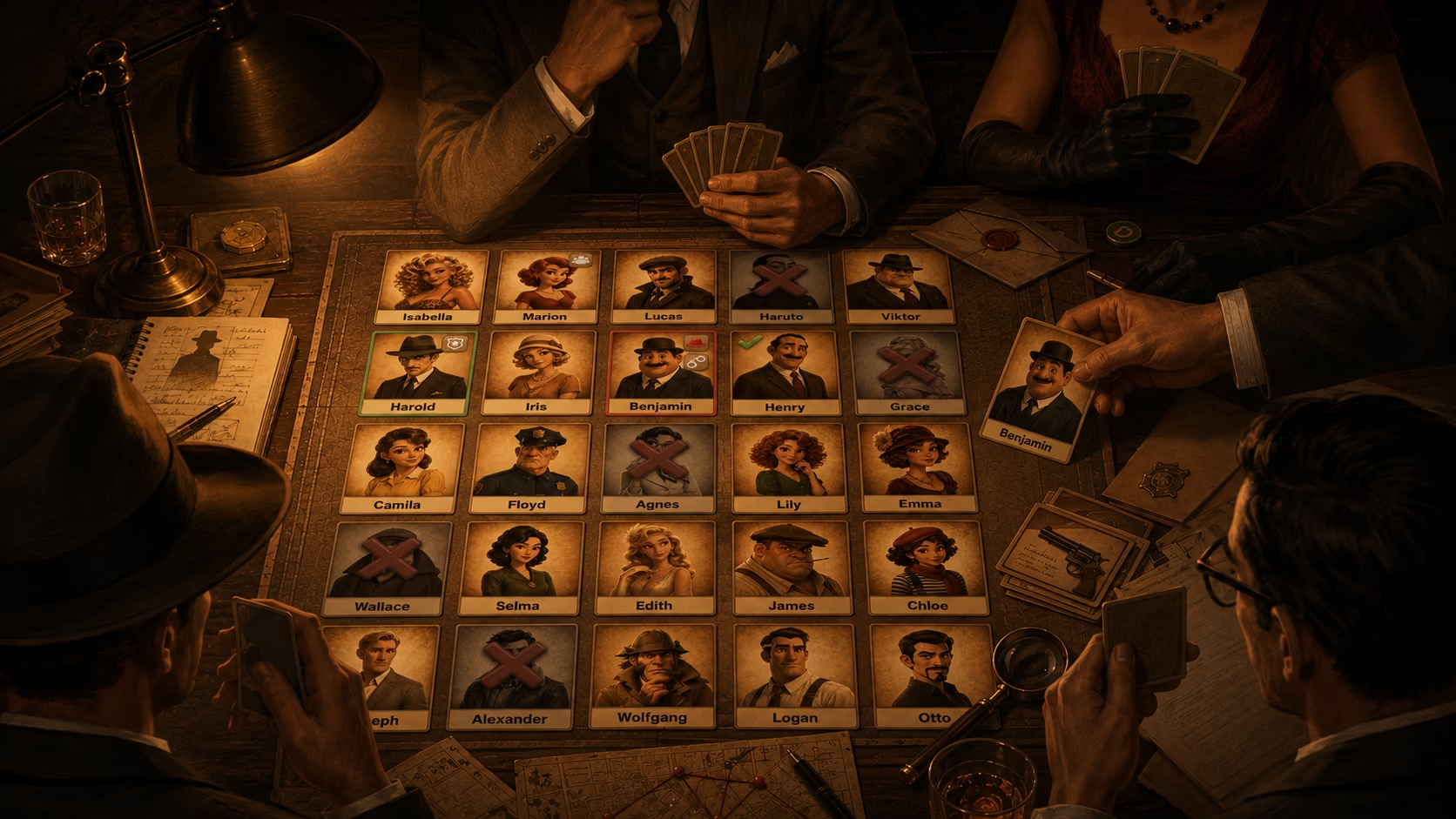
NOIR is a deduction card game from Level 99 Games in which each player secretly is one of 25 suspects laid out in a 5×5 grid. Players take one action per turn - shifting a row or column, killing or arresting a neighbouring suspect - and use those actions to deduce the opponent's hidden identity before their own is uncovered. Games last roughly 5-15 minutes.
The full boxed product is sold as NOIR: Deductive Mystery Game, and it's a collection rather than a single game - the publisher's listing advertises four game modes in the box. The two-player mode NOIR: Killer vs Inspector is the one most players mean when they talk about NOIR, and it was also released on its own.
What makes it feel different from a conventional card game is that the cards aren't your hand - they're the map and the players. The 25 suspects are the board, the pool of possible victims, and the two secret identities all at once. There's no engine to build: you get one action per turn and a slowly narrowing list of people your opponent could be. The roles are asymmetric too, so the deduction problem isn't symmetrical either - one player is hunting a person, the other is dodging a net.
How Does NOIR Work?
Setup is quick. Deal 25 suspect cards into a 5×5 grid, keep the matching evidence cards to one side, and each player is secretly assigned an identity among those 25 faces.
Turns then alternate, one action each. The available actions differ by role, but they fall into a few families:
- Move the grid - rather than moving a pawn, you shift a whole row or column one step. Your identity slides with it, which is how you close distance on a target, or open distance from someone getting uncomfortably close.
- Act on a neighbour - most decisive actions only work on a suspect adjacent to your own identity, so getting into range is half the game.
- Gather information - the investigating side clears suspects and pulls evidence; in the advanced variant, some actions also hand out proximity clues about how close your identity is to the card acted on.
- Change your identity - the criminal side can attempt a disguise when the net closes, a limited resource rather than a free escape.
Because the grid physically moves, information decays. A deduction that was rock-solid two turns ago can be worthless after a couple of shifts - and the shifts are themselves evidence, since a row nobody had any reason to touch just moved.
The objective depends on the mode you're playing, which is where Killer vs Inspector comes in.
NOIR Killer vs Inspector Explained
Killer vs Inspector is the flagship two-player mode, and the one the NOIR Killer vs Inspector rules questions are usually about. It's a strict duel: one player is the Killer, one is the Inspector, and both are hiding among the same 25 suspects.
What each side is trying to do
The Inspector wins by arresting the Killer - correctly naming which suspect card the Killer secretly is, while standing next to it.
The Killer wins one of two ways: by killing the Inspector's secret identity, or by racking up a body count (16 dead characters in the published rules) before the Inspector pins them down.
That asymmetry sets the tempo. The Killer has a clock working in their favour and a reason to keep acting; the Inspector has to gather information faster than the bodies pile up.
Why neither player has full information
It's tempting to think of the Inspector as the one doing all the deducing, but both sides work blind. The Killer doesn't know which of the 25 faces the Inspector is either - so every kill is a gamble that might hit the Inspector and win outright, or hit a bystander and hand over a clue.
That clue is the heart of the mode. To kill someone you have to be next to them, so a kill announces that your identity is adjacent to that card. The Inspector immediately has a short list. The Killer's counter is to make that list expensive to shorten: shift rows to break adjacency, kill in spots that implicate several possible positions at once, or burn a disguise and invalidate everything the Inspector has worked out.
The Inspector's actions leak the same way. Clearing a suspect, arresting the wrong person, or reaching for one corner of the grid all suggest roughly where the Inspector is standing - and the Killer only needs to get that right once.
The cat-and-mouse dynamic
Put those together and you get the loop players come back for. Each side has to act to make progress, and acting is the only thing that gives them away. Sit still and you learn nothing; act and you teach your opponent something. Rounds are short - often five to fifteen minutes - so a match is usually a couple of sharp reads rather than a long grind.
Why NOIR Works So Well as a Deduction Game
- Actions double as evidence - there's no separate clue system to maintain. Doing anything useful is what tells your opponent something, so every turn is a cost-benefit call.
- The deduction is spatial - you aren't crossing names off a list, you're reasoning about a position on a moving grid, which feels closer to an abstract strategy game than a whodunnit.
- Bluffing is cheap and legal - move rows you don't care about, threaten suspects you have no interest in. Misdirection costs a turn, not a card.
- A tiny action list, a lot of situations - four or five verbs, 25 cards and one moving grid produce far more distinct positions than the rules length suggests.
- You have to model what your opponent knows - good play isn't just who could they be, it's what do they now think I could be.
If you like hidden-information card games, detective games, or the positional side of abstract two-player games, that combination usually lands. It isn't chess - there's dealing, hidden identities and real luck in what the grid hands you - but it rewards the same habit of thinking a move ahead instead of hoping for a good draw.
Can You Play the NOIR Card Game Online?
Yes. Killer vs Inspector is playable free in a browser on Board Game Arena, which offers both the advanced variant with canvassing and a stripped-down classic variant. NOIR is also on Tabletopia, a browser-based virtual tabletop with a free tier where you handle the physical components digitally.
Board Game Arena is a proper implementation: it enforces the rules, finds you opponents and handles turn order, in real time or asynchronously. Tabletopia is closer to a digital table with the cards on it - nothing is automated, so you and your opponent apply the rules yourselves. Platform availability does change, so check the current listing first. For a physical copy, the publisher's Level 99 Games store and BoardGameGeek are the reliable starting points.
Worth naming, though: a fair share of people searching for a NOIR card game online aren't hunting that specific title at all. They want the experience - a short, sharp, hidden-identity duel they can start in a browser right now, without an account, a purchase, or waiting on a human opponent's turn.
Looking for a Game Similar to NOIR? Try The Alibi
The Alibi is a separate browser-based deduction game - not a NOIR product, and not affiliated with Level 99 Games - but it's built around the same core problem: two hidden identities on a shifting grid of suspects, each side reading the other's moves.
Its two-player mode, Inspector vs Mafia, will feel structurally familiar if you know Killer vs Inspector. There's a grid of suspect cards, each player secretly is one of them, and each turn you pick one action: shift a row or column, kill or arrest a neighbour, interrogate, or - as the mafia - masquerade as someone else. The inspector wins by arresting the right person; the mafia wins by killing the inspector's identity or reaching a kill count.
What it adds is the browser side:
- Plays in a browser, no download or install
- Free to play; online matches just need a nickname, not an account
- Online multiplayer rooms, or a quick match straight from the home page
- Local hot-seat play in a single tab if you're sharing a laptop
- Bot opponents - an AI service plays the deduction modes, so you can practise or play alone at any hour
- More modes beyond the duel: Spy Games for larger groups (three players and up, free-for-all or fixed teams) and FBI vs Mafia for team play, both on the same shift, catch and investigate mechanics
The mechanics aren't identical, and the two games play differently in detail - the action lists differ, the numbers differ, and The Alibi's group modes have no two-player equivalent. But if the part of NOIR you enjoy most is the cat-and-mouse between two hidden identities on a board that won't stay still, The Alibi works on the same problem in a format you can open in a tab. The game modes page has the full breakdown, and what is Alibi walks through how a match plays out.
NOIR vs The Alibi
| Feature | NOIR | The Alibi |
|---|---|---|
| Deduction gameplay | Yes | Yes |
| Hidden identities | Yes | Yes |
| Positional play on a suspect grid | Yes (5×5 grid, shifting rows and columns) | Yes (shifting suspect grid) |
| Criminal vs investigator roles | Yes (Killer vs Inspector) | Yes (Inspector vs Mafia) |
| Multiple game modes | Yes (four modes in the boxed edition) | Yes (Inspector vs Mafia, Spy Games, FBI vs Mafia) |
| Physical components | Yes | No - digital only |
| Browser play | Yes, via third-party platforms (Board Game Arena, Tabletopia) | Yes, on its own site |
| Free browser access | Yes, on both platforms' free tiers | Yes |
| Local same-device play | Yes - it's a physical card game | Yes (hot-seat in one browser tab) |
| Play against AI bots | Not part of the physical game; depends on the platform | Yes |
| More than two players | Yes, in some modes in the box | Yes (Spy Games, FBI vs Mafia) |
These are two separate titles by different creators, and the table compares the kind of experience each delivers - not a claim that they play the same. NOIR is a published physical card game with its own rules, art and modes; The Alibi is an independent browser game exploring similar territory.
Who Should Try The Alibi?
It's likely to land if you enjoy Killer vs Inspector specifically and want more of that duel; like hidden-identity games where the tension comes from reading a person rather than drawing a card; prefer deduction over randomness; want short sessions that fit into a break; want to practise against a bot first, or play at 2am with nobody around; or are looking for games like NOIR that don't need a purchase or a download to try.
Browsing more broadly? Our roundups of online card games and free logic games cover neighbouring ground.
Other Games to Try If You Like NOIR
- Mr. Jack - an asymmetric two-player hunt on a shifting board: one player hides an identity in plain sight, the other narrows the suspects down.
- Codenames: Duet - two-player deduction on a grid of words, where every clue also reveals how you think.
- Hanabi - cooperative rather than adversarial, but the same discipline of reading meaning into limited signals.
- Deception: Murder in Hong Kong - group deduction where the murderer is at the table and evidence has to be interpreted, not just collected.
- Spyfall - lighter and conversation-driven, for groups who want hidden-identity tension without a board.
Final Thoughts
NOIR holds up because it does a lot with very little: 25 cards, one action a turn, and a board that shifts under both players. The deduction is genuinely two-sided, the misdirection is built into the legal moves, and a match resolves in the time it takes to make coffee.
If what you want is a browser-based version of that feeling - hidden identities, positional deduction, investigator against criminal, playable right now - The Alibi is the closest thing you can start in a tab. Free, no download, and bots if you'd rather learn first.
Explore The Alibi's game modes and rules · Practise against an AI opponent
FAQ
NOIR is a two-player deduction card game from Level 99 Games in which both players are secretly one of 25 suspects laid out in a 5×5 grid. You take one action per turn - shifting rows, killing or arresting neighbours - and try to identify your opponent before they identify you. It is sold as NOIR: Deductive Mystery Game and plays in about 5-15 minutes.
The Killer wins by killing the Inspector's secret identity, or by killing enough characters (16 in the published rules). The Inspector wins by correctly arresting the Killer's suspect card. Both players hide among the same 25 suspects, so every action - a kill, an arrest, an exoneration - reveals roughly where the acting player is standing on the grid.
Yes. Killer vs Inspector is playable free in a browser on Board Game Arena, in both an advanced and a classic variant, and NOIR is available on Tabletopia's browser-based virtual tabletop. Platform availability can change, so check the current listing first.
Mr. Jack, Codenames: Duet, Hanabi, Deception: Murder in Hong Kong and Spyfall all scratch parts of the same itch. For a browser-based hidden-identity duel on a shifting suspect grid, The Alibi is the closest online alternative.
No. They are two separate games by different creators. The Alibi is not an official, licensed or digital version of NOIR and has no affiliation with NOIR or Level 99 Games. It is recommended here because it explores similar ground - hidden identities, investigator-versus-criminal roles, and deduction based on position as much as information - in a free browser format.