What Is Alibi? A Free Online Noir Deduction Game
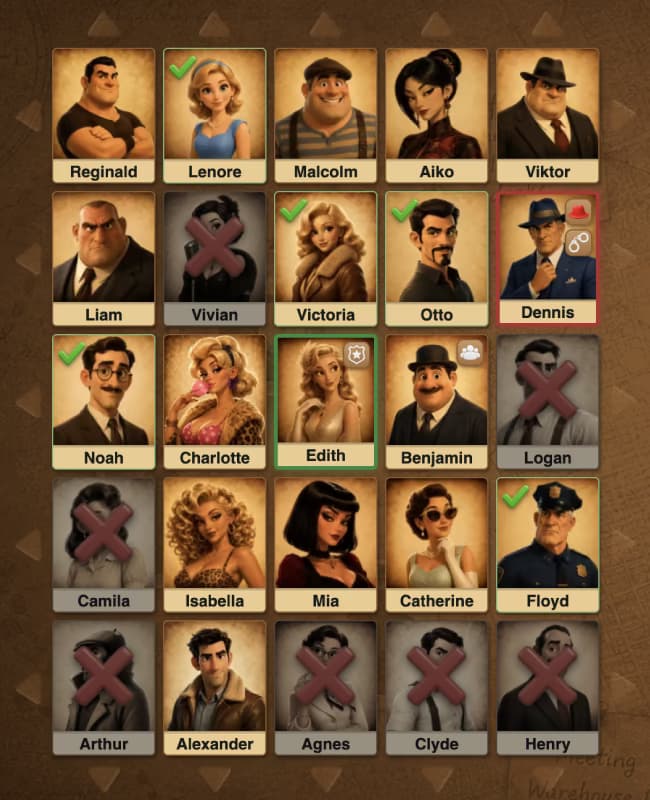
Alibi is a free online noir deduction game built around hidden identities, bluffing, and tactical decisions. Every match takes place on a shared board of character cards, where an opponent's identity may be concealed behind any one of the suspects on the table.
Depending on the selected mode, players take on roles such as Mafia, Inspector, spies, or FBI agents, each with different objectives and abilities. Every action can reveal information, create a false trail, or change what the other players believe about who is really who.
You can practise against AI-controlled bots, join other players through online lobbies, or start a local match on the same device. Available modes range from focused 1v1 duels to larger hidden-identity and team-based matches.
A Noir Game Built Around Hidden Identities
Alibi earns the “noir” label through crime, concealed motives, and incomplete information, not just a dark color palette. Every match puts suspicious characters and secrets at the center of play: someone at the table is hiding, and the rest have to work out who while deciding how much of their own hand to reveal.
That atmosphere isn't limited to shadowy card art or a case-file interface. It comes from the gameplay itself: players act without full information and have to interpret suspicious moves made by others. Moving a character, targeting a suspect, clearing someone as innocent, or avoiding part of the board entirely can each be a genuine tactical decision or a deliberate attempt to mislead an opponent - and you rarely know which until it's too late.
How Alibi Works
A match takes place on a shared layout of character cards, and one or more players hold a secret identity tied to a specific card on that board. Depending on the mode and role, a turn might mean gathering information, narrowing down suspects, interrogating or investigating a card, shifting part of the board, protecting an identity, or moving to expose an opposing role.
Every visible action becomes information. Targeting a particular suspect can suggest a player knows something; repeatedly protecting one area can create suspicion on its own; shifting the board changes which identities remain possible; clearing one suspect makes the ones left over more important. An action that looks helpful might have been chosen precisely to build a false trail.
The real challenge isn't just learning what each action does. It's asking why another player chose that particular action at that particular moment.

Inspired by NOIR, Reimagined for Browser Play
Alibi's developers were inspired by the tabletop game NOIR: Deductive Mystery Game - specifically its suspect cards, concealed asymmetric roles, and deduction based on reading another player's actions across a shared card layout. Alibi is an independent game. It is not an official digital adaptation of NOIR: Deductive Mystery Game and is not affiliated with Level 99 Games.
Beyond that shared inspiration, Alibi runs on its own code, interface, online systems, AI bots, and set of game modes, all built specifically for browser play. That means online multiplayer with lobbies, local same-device matches, several modes that support different player counts and objectives, and team-based play in the modes that support it - none of which depend on a physical board or deck.
Alibi Game Modes
Alibi isn't built around a single fixed ruleset. Each mode changes player count, available roles, whether you compete alone or in a team, and how identities are assigned and uncovered.
Inspector vs Mafia
A focused 1v1 duel on a 5×5 board. One player is secretly the Mafia, hidden among 25 suspects; the other is the Inspector, holding a hand of evidence cards. The Mafia shifts the board, kills adjacent suspects, or masquerades into a new identity (a limited number of times per game); the Inspector shifts, interrogates suspects to clear them and sense the Mafia's presence nearby, replaces cards in hand, or arrests - directly or through a blind citizen arrest. Every action matters in a match this small, and reading one opponent's habits over a full game is a large part of the appeal.
Spy Games
A larger mode for 3 to 10 players, played free-for-all or in fixed teams (2v2 up to 5v5). Every player secretly becomes one of the suspects on a board that scales with player count. Actions are Shift, Reveal (accuse a nearby suspect - a hit against an opponent scores a trophy, and they get a new identity), and Investigate (check a suspect and let everyone learn who is in or near it). With several suspicious players instead of just one, deduction becomes harder: you're narrowing down more than one hidden identity at once, and a caught player simply gets a fresh one and keeps playing.
FBI vs Mafia
Alibi's newest mode pits two secret teams against each other on one shared board: FBI agents hunting for Mafia identities to arrest, and Mafia hunting for FBI agents to eliminate. Sub-modes include Standard 3v3 and Standard 4v4, where six or eight players each control one character, and Duel 3v3 / Duel 4v4, where a single player controls an entire team of three or four characters. FBI roles include the Undercover Agent, Detective, and Operative (plus the Criminalist in 4v4); Mafia roles include the Bandit, Maniac, and Bomber (plus the Sniper in 4v4), each with its own action set alongside the shared FBI Arrest action. Teammates always know each other's identities; the opposing team never does, which makes team-based coordination and reading both allies and opponents a bigger part of the challenge than in a 1v1 match.

Play Online, Locally, or Against AI
However you prefer to play, Alibi supports it: organize a match through an online lobby, pass one device around a room, or start a game against AI-controlled bots.
Online Multiplayer Lobbies
Alibi's online matches are organized through a lobby system: create a room, choose a supported mode and its settings, and wait for other players to join. The host can assign roles or seats, fill an empty seat with a bot, or remove a player before starting, and everyone can mark themselves ready once the room has what it needs. It's a straightforward way for a group of friends to agree on a mode and get a match started together, or for larger team modes to gather everyone required in one place before play begins.
Local Same-Device Matches
Alibi can also be played locally, with everyone in the same room sharing a single device - no accounts needed. It plays out closer to a tabletop card game: pass the device when a mode calls for it, and work through the same secret identities, bluffing, and tactical decisions as an online match, just without needing separate logins or a group of people online at once.
Matches Against AI Bots
Alibi's bots are AI-controlled opponents, not players choosing actions at random. In Inspector vs Mafia, the bot is trained through self-play and also learns from completed human matches recorded after they finish; in Spy Games, a bot built on the same search-based approach, generalized for team play, drives its seats. Both evaluate the current board, the actions available to them, and the identities that are still possible before choosing a move - and both are bound by the same information limits a human player in their seat would have, so a bot never acts on a hidden identity it isn't actually allowed to know. Bot seats are also available in FBI vs Mafia, letting you fill an empty controller slot to start a match without a full lineup.
Practising against bots is a low-pressure way to learn the rules, get familiar with a role, and try out risky moves before taking them online. Human opponents bring something different - unpredictable bluffing, personal habits, and social behaviour a bot doesn't reproduce.

Why Every Match Feels Different
Secret identities change between matches, and starting board layouts put different suspects next to each other every time. Players approach the same role differently too - one opponent might bluff aggressively while another plays cautiously, and a strategy that worked in one match can become predictable, and beatable, in the next. Team modes add cooperation and extra uncertainty on top of that, and bots and human opponents each create a genuinely different kind of challenge. The uncertainty comes from hidden identities, board changes, and the decisions of whoever - human or bot - is sitting across from you, not from any single fixed puzzle to memorize.
Why Alibi Is Interesting to Play
Every turn has a visible consequence: an action can reveal information about the player who took it, or just as easily be shaped to create a misleading pattern. Reasoning about the board isn't enough - you're also reasoning about the player who last changed it. Spatial positioning matters, hidden identities mean the same board reads differently depending on your role, and players sometimes have to choose a safe move over an informative one, or the reverse.
1v1 modes reward closely reading a single opponent's habits over a full match; larger modes trade that for more uncertainty, and team modes add coordination on top of deduction. AI opponents give a low-pressure place to try a risky read before an online match, where human opponents bring the unpredictable deception a bot can't. What ties it together is that Alibi connects deduction directly to board decisions - you're not just answering a mystery at the end, you're actively changing the situation while trying not to give away your own plan.
Who Might Enjoy Alibi?
Alibi tends to appeal to people who enjoy classic Mafia, Among Us, or hidden-role and social deduction games generally, along with players familiar with NOIR: Deductive Mystery Game. It also fits fans of card games and tabletop strategy, and players who enjoy tactical turn-based games - including chess or checkers players who like reading a position and anticipating an opponent's next move. It's a reasonable fit for friends looking for a local game, groups wanting an online multiplayer session, or anyone who'd rather practise against AI before playing other people - all without a large download.
Fans of L.A. Noire, Disco Elysium, or Chicken Police: Paint it RED! may also find something familiar in Alibi's crime, investigation, and morally uncertain characters, even though Alibi isn't a story-heavy single-player detective campaign like those games. What it offers instead is a competitive, replayable take on the same noir themes: suspicion, hidden motives, and decisions that don't come with a guaranteed right answer.

Is Alibi Worth Trying?
Alibi is worth trying if you want a free browser game with a noir atmosphere, hidden identities, and turn-based bluffing and deduction that doesn't depend entirely on voice discussion. It offers matches against AI, online multiplayer, local same-device play, and several modes rather than one fixed format, in short and focused competitive sessions.
It's probably not the right fit if you're looking for a long cinematic campaign, an open world, fast real-time action, or a story-driven mystery with one predetermined solution. Alibi is a competitive board of hidden identities, not a narrative adventure - knowing that going in should make trying it an easy call either way.
Follow Alibi's Development
Alibi is an independently developed game that keeps evolving. Follow Alibi's development to see new characters, gameplay updates, AI bot progress, and announcements about upcoming modes.
Play Alibi for Free
Alibi is a free browser-based noir deduction game where every suspect can matter and every action may reveal more than a player intended. Practise against an AI bot, create or join an online lobby, or start a local match with someone in the same room. Choose from focused 1v1 deduction, larger hidden-identity matches, or team-based play, protect your role, study the board, and work out who's hiding among the suspects.
Explore Alibi's game modes and rules · Practise against an AI opponent
FAQ
Yes. Every mode - Inspector vs Mafia, Spy Games, and FBI vs Mafia, online, local, or against AI - is currently free to play, with no purchases required.
Yes. Alibi runs directly in a web browser on desktop or mobile, with no separate app store listing.
No. Alibi is browser-based - open it and start playing without installing anything.
Yes. AI-controlled opponents are available in Inspector vs Mafia and Spy Games, and bot seats can also fill empty slots in FBI vs Mafia.
The bots are trained through self-play, and Inspector vs Mafia's bot also learns from completed human matches. They evaluate the board, the actions available to them, and the identities still possible, while still operating only on the information their role would legally have.
Yes. Players can create or join lobbies, assign roles or seats, add bots to fill empty spots, and start a match once everyone required has joined.
Yes. Alibi supports local, same-device play for its modes - pass the device around a room and play without needing separate accounts online.
It shares secret roles, deception, and deduction with classic Mafia, but Alibi builds much of its evidence directly into the board - character positions and visible actions - rather than relying mainly on group discussion.
Alibi shares Among Us's appeal of hidden enemies and suspicious behaviour, but it's turn-based and built around character cards on a shared board rather than real-time movement around a map.
No. Alibi is independently developed, inspired by the appeal of hidden-identity card deduction, and is not affiliated with Level 99 Games.
Inspector vs Mafia (a 1v1 duel), Spy Games (free-for-all or team play for 3-10 players), and FBI vs Mafia (team-based, including Standard and Duel sub-modes).